
Colombian Cuisine is full of life, culture and “sazón”
The other day, a friend asked me a genuine question:
“If Colombia is so rich in flavors, ingredients and tradition, why isn’t its cuisine more famous internationally?”
And I understood where the question came from.
Colombian food is not always as intricate as French cuisine, or as gourmet-marketed as Peruvian. But what we do have — in abundance — is sazón.
And sazón is more than seasoning.
In Colombia, sazón describes food that is full of flavor, soul, and intention — but it’s also the word we use to describe someone who dances beautifully, with rhythm and passion. A person with sazón is someone alive in every sense: someone who moves through the world with joy, creativity, and presence.
It’s no coincidence that the people who dance with sazón often cook with it too. Because sazón is not a technique — it’s a way of relating to life. A way of putting love, generosity, and feeling into everything you create, whether it’s a dish, a song, or a moment shared around the table.
Colombian gastronomy may not have made global headlines yet — but it holds flavors that deserve them. If Michelin stars were awarded based on cultural meaning, emotional memory and soul, these dishes would already have them:
1. Plátano maduro with cheese
In Colombia, plantain is not just food — it is part of our identity. We have many varieties, but plátano maduro (ripe plantain) is one of our treasures.
The best version is simple and ancient:
plantain roasted — often over wood fire — split open and filled with fresh cheese.
The result is a flavor that is almost impossible to describe:
sweet and savory at the same time, comforting, primal, and deeply satisfying.
A dish with only two ingredients, yet infinite memory.
2. Encocado de camarones
In the Pacific coast of Colombia, food is poetry written in coconut.
Encocado de camarones is a dish made with prawns simmered in a stew of tomato, onion, garlic, herbs, and most importantly: fresh coconut milk, grated and pressed by hand that same morning.
It has a balance that feels effortless — rich but not heavy, comforting but delicate.
It tastes like the ocean, the jungle, and the tradition of Afro-Colombian kitchens that have perfected the art of transforming simple coastal ingredients into something unforgettable.
You don’t just eat encocado — you slow down for it.
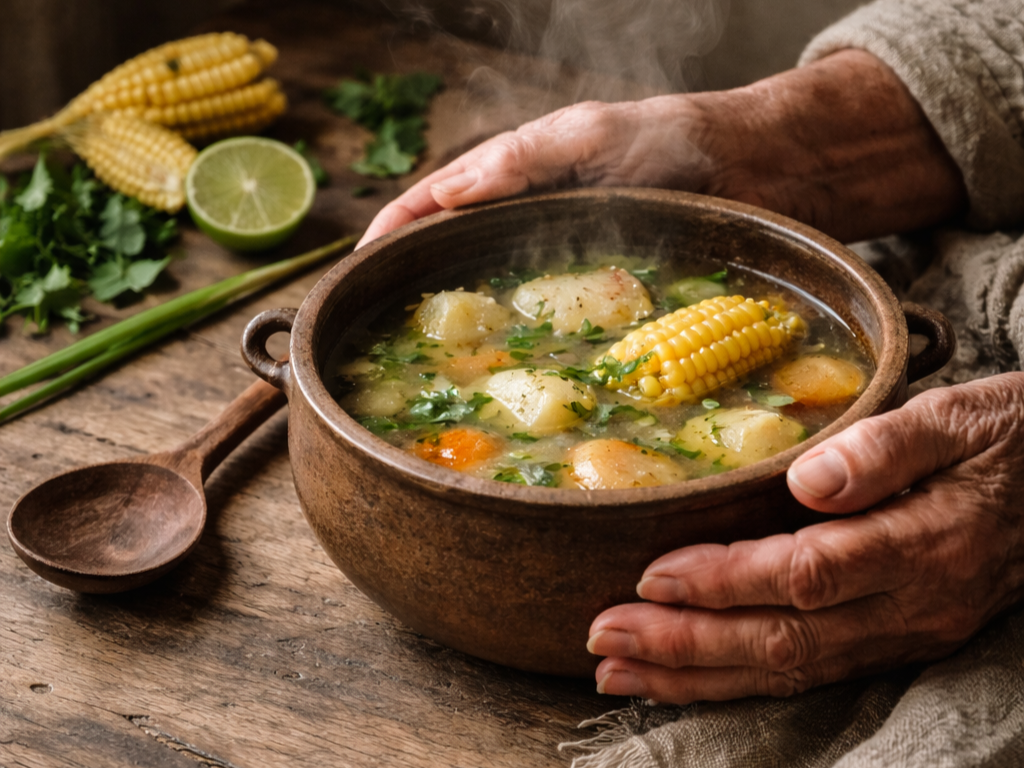
3. Sancocho cooked over fire
If Colombia had a national soup, it would be sancocho.
But sancocho is not just a dish — it is an event.
On Sundays, families gather and cook enormous pots, enough to feed everyone who walks through the door. Friends are invited, neighbors show up, music is played, and stories are told. Sometimes, people carry the pot all the way to the river and cook the sancocho over wood fire while swimming, talking, and laughing.
That alone deserves recognition.
But the flavor takes it even further.
Sancocho can be made from fish, or as the legendary trifásico — a combination of beef, chicken, and pork slow-cooked for hours until the broth becomes deep and smoky with the taste of firewood. Served with perfectly ripe avocado, it is the kind of meal that tastes like family, memory, and belonging.
4. The arepa in all its forms
You cannot understand Colombia without understanding corn.
Arepas are our daily kind of bread — made of ground corn cooked into a dough and prepared in hundreds of variations across the country:
thin and toasted in Bogotá
thick and buttery in Antioquia
filled with cheese on the Caribbean coast
made with sweet corn in the valleys
grilled, fried, steamed, or baked
Every region has its own interpretation, and every Colombian has their favorite.
For many of us — including me — corn is nourishment, comfort, and happiness.
Arepas are simple, yes. But what they represent is profound: identity, continuity, and the beauty of everyday flavor
So why isn’t Colombian cuisine more famous yet?
Maybe because its greatness isn’t always found in haute cuisine techniques,
but in wood fires by the river,
grandmothers cooking without measuring,
markets overflowing with fruits you’ve never seen before,
and kitchens where food is made with music, conversation, and sazón.
Colombian food is not just about taste —
it’s about the feeling that comes with every plate.
And maybe that’s the beauty:
some cuisines are made to impress,
ours is made to be lived.
If you come with an open heart, Colombia will feed you in a way that stays long after the meal ends
¿Are you ready to experience our Sazón?
